 For a couple of years the prospect of the World’s largest sporting event coming to Australia has been talked about amongst Australian sporting circles. Some would have you believe that Australia is no chance of ever hosting a FIFA World Cup, others think it will be an easy task to win the bid.
There is no doubt about the impact the event could have on Australian football. Aside from bringing the FFA massive amounts of money, hosting the tournament would likely mean new stadiums for A-league teams and could generate a surge in interest that could finally propel football to the top of the Australian sporting landscape. But is it going to happen?
Over a couple of blogs I’m going to try and answer that question. First I will ask the question about whether it is logistically and financially possible for Australia to host such a huge event. Secondly I will look at our competitors, and try and make an assessment about whether or not we can crawl through the “seedy” political mess of FIFA to win the hosting rights.
Part 1 – Logistics/Stadiums
One of the major issues with the logistical side of hosting a tournament like this is the cost. In 2006, just under $3 Billion Australian Dollars were spent on stadiums, but that number is dwarfed by how much the German Government estimates they got back – close to $30 Billion.
 Much of the money made from the tournament is due to a massive surge in tourism. The 2006 tournament drew 3.5 million people to Germany. It is difficult to predict if Australia could expect similar numbers, it is a much longer journey for fans from Europe and the Americas. However I think this could be cancelled out by large numbers of tourists from Asian countries. The 2006 tournament was held in Europe, yet more fans came from Japan than most European countries – only England, the USA and Germany itself beat the Japanese in terms of total number of fans.
Money will also need to be investment in transport infrastructure – I am certainly no expert on the subject, but new airports/railway stations would just be another way that the FIFA World Cup would be of benefit to Australia.
Stadiums
When discussing Australia’s World Cup bid – this is something that gets talked about the most. Where are games going to be played? Is this stadium going to be good enough or big enough for World Cup matches? Will that satisfy the FIFA requirements?
 Firstly, what are these FIFA requirements? What conditions does a stadium need to satisfy to be included as part of a World Cup bid. Before I go on, let me say that FIFA is FIFA – they make the rules, they can bend the rules, and really there is no such thing as a FIFA ‘requirement’ for a World Cup stadium. There are standards that FIFA would like stadiums to meet, but if they think a stadium is appropriate, they aren’t going to get obsessive about details. The FIFA ‘requirements’ are really just guidelines that a country can look at as it plans a World Cup bid.
Here is basically what you need to look at while thinking about World Cup venues:
- Capacity: Stadiums should be able to hold at least 40,000 people, and should be all seated. There should be at least 3 stadiums that hold more than 60,000 for semi finals and the World Cup final.
- Viewing Experience: Fans at the stadiums should be able to get a good view of the game from any position. FIFA do have specific details about maximum distance from the pitch, but as long as all fans get a decent view, the technicalities will not matter.
- Location: Generally FIFA has a one-city, one-stadium policy, however exceptions to this have been made in the past. Something that gets thrown up a lot is that FIFA will allow one city to have multiple stadiums, but no more than that. I have yet to find any sort of official source for this, and I expect it may not be true. Going back to my earlier point though, FIFA are not stupid – they aren’t going to enforce a bunch of rules just for the sake of it. It could certainly be argued that, because Australia is a country with a lower number of large cities, we are a different case to many past FIFA World Cup host countries. Another thing to consider is the distance between host cities – something that may be of concern for Perth.
- After-tournament Use: FIFA likes stadiums to leave a ‘legacy’ for football for years to come. This makes a lot of sense, and we have already seen how much the Korean K-league and Japanese J-league have benefited due to modern stadiums after the 2002 World Cup. This is important for the government as well, it’s a lot easier to spend money on a stadium if you know it will have lasting benefits.
At a basic level, that is really it. Other requirements are technical things that can be done at a relatively low cost (a completely flat pitch is one example) – and as long as you have a good stadium these should not be an issue. The minimum number of venues needed is 10, and with good upkeep of grounds (ensuring quality of turf etc.) no more than this should be needed – although it would be beneficial to bring the tournament to as many cities/towns as possible. Maintaining playing surfaces may also be a little tricky in the middle of Winter.
So let me go through where I think World Cup games could potentially be played, when and if Australia ever hosts a FIFA World Cup. I will do an estimate of how much might be needed to be spent upgrading or building a venue, to try and determine how easy it would be for Australia to afford this tournament. Let’s start with venues that will definitely host games:
Definite Host Venues:
- Brisbane –> Suncorp Stadium

Capacity: 52,500 -> Upgrade to ~ 60,000
Upgrade Cost: $120 Million
Suncorp Stadium is an obvious choice for a World Cup venue. Really it would need no money spent on it at all for it to be a perfect World Cup venue. Although a little could be spent upgrading the capacity a little, so that it is an option for a semi-final. For this and any other small improvements I have allocated $120 million.
- Newcastle –> Energy Australia Stadium
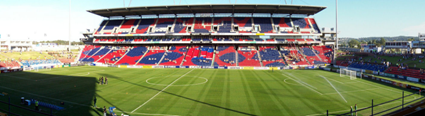
Capacity: 27,000 –> Upgrade to ~ 45,000
Upgrade Cost: $120 Million.
Newcastle is, in my opinion, also a definite host venue. Newcastle is Australia’s 7th biggest city, and will be needed if we are to get the required number of venues. Energy Australia Stadium is already undergoing upgrades to give it a capacity of around 35,000 and there are already plans in place to get the capacity to over 40,000. A lot more work needs to be done to make it a world class venue, but I have no doubt that will be done. My guess is it might need $120 million.
- Homebush –> ANZ Stadium

Capacity: 83,000 –> Slight Capacity Upgrade to ~ 85,000
Upgrade Cost: $50 Million
Another obvious choice, Stadium Australia in Sydney is a truly World class venue. The only slight problem with the venue is that it is not completely rectangular, although the view for fans at ANZ stadium would be far better than at most oval venues. Homebush would probably host either the Final or the Opening game. Capacity could potentially be increased a little, I’ll allocate $50 million for some minor upgrading.
- Sydney –> Sydney Football Stadium

Capacity: 45,500 –> Upgrade to ~ 50,000
Upgrade Cost: $50 Million
In my view, the Sydney Football Stadium will be a definite World Cup venue. It is a second stadium in Sydney, but with ANZ Stadium in out in Sydney’s West, a venue in central Sydney would make a lot of sense. The facilities etc. could use a bit of work, and expansion to around 50,000 would be possible, so I’ll allocate $50 million.
Probable Host Venues:
- Gold Coast –> Skilled Park

Capacity: 27,500 –> Upgrade to > 40,000
Upgrade Cost: $150 Million
Australia’s 6th largest city is very likely to be used in a World Cup bid – and Skilled Park is a very nice, modern stadium that is likely to be used. Expanding Skilled Park could be a little tricky, but as long as the Gold Coast’s A-league and rugby league clubs are successful, an expansion to over 40,000 will be quite feasible. I imagine that a second tier would need to be built on one (or both) sides of the stadium. This would likely cost close to $150 million.
- Canberra –> Canberra Stadium

Capacity: 25,000 –> Upgrade to > 40,000
Upgrade Cost: $200 Million
It seems likely to me that the nation’s capital will be used in any world cup bid. With NRL and Super 14 clubs, and hopefully an A-league club within a few years, Canberra stadium is in a good position to argue that an expansion is warranted. It would need to be a fairly significant upgrade though, as the ground would need a lot of work.
- Melbourne –> MCG

Capacity: 100,000
Upgrade Cost: $20 Million
Despite not being the best place to watch football, I expect the MCG will end up being used if Australia ever hosts a World Cup. The capacity of 100,000 is too hard to ignore, and really the view that fans get at the stadium is no worse than you get at places like Nissan Stadium (host of the 2002 World Cup final). If it does get used, it is likely to host the World Cup final, which FIFA will insist should be played at the largest stadium. I’ve allocated $20 million for general upgrades.
- Adelaide –> ???

Capacity: Build with ~ 65,000
Build Cost: $800 Million
Currently Adelaide has no venue that is a chance of hosting World Cup games (although it would be possible to upgrade either AAMI Stadium or Adelaide Oval, but that would basically require knocking down the stadium and starting again anyway). However I think we can be virtually certain that games will end up being played in Adelaide. There are really two options for Adelaide – a rectangular stadium, which would hold a little over 40,000 - or a multi-purpose venue that would hold, maybe, 65,000. Obviously the only use for a rectangular venue would be Adelaide United games, as well as maybe the occasional Socceroos match and a couple of rugby games. A multi-purpose venue could be used for AFL as well, which would make it a lot more viable. Whether or not that will happen remains to be seen. Depending on which option is chosen, something like $800 million could be needed for the new venue.
- Perth –> ???

Capacity: Build with ~ 60,000
Build Cost: $1 Billion
The planned new super-stadium in Perth, which would have been a perfect venue for World Cup matches, is currently in limbo. Around 12 months ago, the venue was ‘confirmed’, but now with a change of local government it appears unlikely to be built. Perth also has another major disadvantage, in it’s location. If Perth is used for World Cup matches, it is doubtful that it would see any matches beyond the group stage (asking a team to travel across the continent for a single crucial game would put them at a disadvantage). My guess is that Perth will end up building a suitable venue, and that it will be used to host one group during the group-stage – there is some chance that Perth might not be used at all though, so the local government will need to be willing to get a new venue built.
Possible Host Venues:
With 9 venues so far, only one more is really needed (although it would be nice to have 12 venues, the same number as were used in 2006).
- Townsville –> Dairy Farmers Stadium

Capacity: 27,000 –> Upgrade to > 40,000
Upgrade Cost: $150 Million
With NRL and A-league sides, it could be argued that Dairy Farmers Stadium would be a good candidate for an upgrade. Townsville does suffer from the problem of being quite a distance from any other venue, so if it were used, matches in the knockout stage would be unlikely. The North Queensland Fury (who will play during the wet season) could certainly benefit from giving fans undercover seating.
- Gosford -> Central Coast Stadium

Capacity: 20,119 –> Upgrade to > 40,000
Upgrade Cost: $200 Million
This one strikes me as an unlikely host stadium, partly because it only has one permanent home team (Central Coast Mariners), and also because expanding the stadium may prove difficult, due to the stadium’s location (they don’t have stands at one end of the ground because there is no room between the stadium, a road, and the sea). It might be possible to get the capacity up to 40,000, but unless the Mariners start getting huge crowds that warrant the increase in capacity – I can’t see it happening. Could definitely be a good training/warm-up match venue though.
- Melbourne -> Swan Street “Bubble” Stadium

Capacity: 33,000 –> Upgrade to ~ 50,000+
Upgrade Cost: $150 Million
Currently under construction, Melbourne’s new rectangular stadium will only be used if the MCG is not able to be used (if it’s decided that it is not spectator-friendly). The “bubble” stadium was built with expansion to 50,000 in mind, so that would certainly go ahead if the stadium was to be used. If it was to be Melbourne’s only venue, I’d wager that the authorities would make sure it was expanded to over 60,000 so that a semi-final could be played there. If not used for the World Cup itself, it would certainly be used for warm-up matches and/or a training venue.
- Docklands –> Etihad Stadium
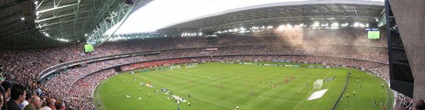
Capacity: 56,000 –> Convert to ~ 50,000
Upgrade Cost: $10 Million
If Melbourne is to have a second venue, it will be Etihad Stadium (FIFA won’t let us use both the ‘bubble’ stadium and the MCG, given that they are so close to each other). The “dome” is beautifully modern, and if it were to be used for the World Cup, the stands could be slid out (and temporary stands built in the corners) to use the stadium in rectangular mode. No real upgrades would be needed, but I’ll allocate $10 million for general upgrades, and to temporarily convert it into a rectangular ground.
- Geelong –> Skilled Stadium

Capacity: 28,000 –> Increase to > 40,000
Upgrade Cost: $200 Million
Skilled Stadium in Geelong has a few significant advantages. Firstly, it’s nice and close to Melbourne. Secondly, an expansion of the stadium to 40,000 would definitely be viable, given the fact that all home games played by the Geelong Cats (an AFL side) are always packed. It is an Oval stadium, but it is quite small and thin for an AFL ground. The big problem would be upgrading the stadium, as it is currently of quite poor quality, so a lot of money would need to be spent (probably $200 million). Personally I don’t think Skilled Stadium would be a bad option.
Unlikely:
There are a few more venues that I could have mentioned, but I don’t think there is any realistic chance of any of these venues hosting matches:
Tasmania – At the moment Tasmania doesn’t even have any sides in any national football competitions. I certainly hope that Tasmania United are successful in their bid to enter the A-league, but even so I can’t see a 40,000 seat stadium being warranted. Some might think that upgrading Launceston’s AFL ground (Aurora Stadium) could be an option, but Aurora’s field dimensions are the same as the MCG’s, without the huge stands – I cannot see any possibility of a Tasmanian venue hosting matches.
 Wollongong – If Wollongong was to secure an A-league team, then an upgrade to Win Stadium might be a possibility, but I can’t see it being expanded to hold 40,000.
Northern Territory – I’ve heard a few people suggest that Darwin should host a couple of games, but this isn’t going to happen – Darwin is not big enough for a decent sized stadium, and it’s too far away anyway.
Cost:
So that’s it - if you think there are any other options, then let me know - but I think the required 10-12 stadiums will have to come from the 14 I’ve mentioned here.
Now – how much will this cost the country? If you add up the total amount I estimated for all 14 venues, it comes to around $3.2 billion dollars. That’s a lot, but when you consider that this number includes two brand new stadiums, and is for 14 venues rather than the required 10-12, Australia wouldn’t need to spend any more than Germany did in preparation for the 2006 edition. Of course with the current financial worries of the world, it’s hard to predict if this number might need to increase a little, but nonetheless I do think that it is financially viable for Australia to be bidding for the World Cup (perhaps that is why the federal government has been so supportive thus far).
My Choice:
So here is my choice for an ideal world cup. I’ve included which games I think each venue would host (remember that a World Cup is comprised of 64 matches – including 48 group stage games, 15 knockout games, and a 3rd place playoff). I’ve also tried to ensure that each ground is not overused, so no ground has more than two knockout matches etc.
Match Venues:
1. Melbourne – MCG – 100,000
> 4 Group Matches (inc. 1 Australian game)
> 1 Quarter-Final (Australia’s likely path)
> World Cup Final
2. Homebush – ANZ Stadium – 85,000
> 4 Group Matches (inc. Opening Match + 1 Australian Game)
> 1 Round of 16 Match
> 1 Semi-Final (Australia’s likely path)
3. Adelaide – New Multi-purpose Stadium – 65,000
> 4 Group Matches
> 1 Round of 16 Match (Australia’s likely path)
> 1 Semi-Final
4. Brisbane – Suncorp Stadium – 60,000
> 4 Group Matches (inc. 1 Australian Game)
> 1 Round of 16 Match
> 1 Quarter Final
5. Perth – New Stadium – 60,000
> 5 Group Matches
> 3rd Place Play-off
6. Docklands – Etihad Stadium – 52,000
> 4 Group Matches
> 1 Round of 16 Game
> 1 Quarter Final
7. Sydney – Sydney Football Stadium – 50,000
> 4 Group Stage Matches
> 1 Quarter Final
8. Newcastle – Energy Australia Stadium – 45,000
> 4 Group Stage Matches
> 1 Round of 16 Match
9. Gold Coast – Skilled Park – 42,000
> 4 Group Stage Matches
> 1 Round of 16 Match
10 Geelong – Skilled Stadium – 42,000
> 3 Group Stage Matches
> 1 Round of 16 Match
11. Canberra – Canberra Stadium – 40,000
> 4 Group Stage Matches
> 1 Round of 16 Match
12. Townsville – Dairy Farmers Stadium – 40,000
> 4 Group Stage Matches
State-by-state breakdown:
Queensland – 12 Group Games + 2 Round of 16 Games + 1 Quarter Final = 15 Games
NSW/ACT – 16 Group Games + 4 Round of 16 Games + 1 Quarter Final + 1 Semi Final = 22 Games
Victoria – 11 Group Games + 2 Round of 16 Games + 1 Quarter Final + Final = 15 Games
South Australia – 4 Group Games + 1 Round of 16 Game + 1 Semi Final = 6 Games
WA – 5 Group Games + 3rd Place Playoff = 6 Games
 I think that is pretty fair on all states. Victoria only has 15 games, but that is made up for by having the final. NSW/ACT have 22 Games, which is to be expected. Queensland gets 15 games, which is good for them, although the last game in Queensland is a quarter final. South Australia only has 6 games, but gets a semi. Western Australia misses out a little, but due to their isolation I didn’t want to make any teams travel there for a knockout game – they host 1 group, but you can’t play all 6 matches from the 1 group at the same venue, as the last 2 games are played simultaneously. I also gave Perth the 3rd place play-off, which the two teams could travel too on their way home.
Another interesting point of note is how many Oval/Rectangular stadiums are used. Although I’ve never seen anything official, FIFA may have some sort of requirement limiting the number of oval stadiums used:
Rectangular Stadiums: Suncorp, SFS, Newcastle, Gold Coast, Canberra, Townsville = 6/12
Oval Stadiums: MCG, Geelong = 2/12
Semi-Rectangular: Homebush, Etihad Stadium = 2/12
Unknown: Adelaide, Perth = 2/12
I call Homebush and Etihad Stadium “semi-rectangular”, because that’s what I believe they are – this picture of Homebush demonstrates that:

I think, to ensure a good quality World Cup, Etihad Stadium needs to be used in rectangular ‘mode’, while the new Perth and Adelaide Stadiums must be built so that they can at least be ‘semi-rectangular’.
Training Venues:
One final thing I quickly want to look at is ‘training venues’. When 32 countries arrive in Australia, they will want to play warm-up fixtures, and to have good facilities to train at. This is a good opportunity for the Football Federation to explore upgrading some A-league grounds, that may not be included in the actual World Cup bid. Some potential venues may be:
 - Hindmarsh Stadium, Adelaide – perhaps an upgrade to 25,000?
- Members Equity Stadium, Perth
- Central Coast Stadium, Gosford (Already Mentioned)
- Swan Street “Bubble” Stadium, Melbourne (Already Mentioned)
- Parramatta Stadium, Sydney – if a West Sydney A-league team is playing there
- Hobart Stadium, Tasmania – if a Tasmanian A-league side ever gets into the A-league.
That’s it for now, in my next blog I will look at the politics of our bid: How easy it will be to stop the AFL/NRL seasons for a month in June, and what sort of competition we have for the hosting rights.
Bye for Now, Matt



 competition, the Bundesliga, this season. Starting with a game between newly promoted Nuremburg and Schalke at 11:30pm this Saturday night - One will show a Bundesliga game live in High Definition every week.
 A lack of football coverage for those without pay-television has long been an issue in Australia, but consider what football will be shown on free-tv in the next 12 months:
![88439298_10 [Desktop Resolution]](https://blogger.googleusercontent.com/img/b/R29vZ2xl/AVvXsEhERmYNOhdEJQcRXjGCy5-t8xwJG6Ju9tJ2tfhhWZm6X7E9MsIwVqbj8ljfE_-pjPzV3JfZnKPu8cCI_d1ExN0-va0bmrEZMTO410PF_ZPTcYhqpdTbhLehWkJcj8uUP3h2EI_HMTDhUuoZ/s1600-h/88439298_10%20%5BDesktop%20Resolution%5D%5B7%5D.jpg "88439298_10 [Desktop Resolution]")


 It’s been about 8 months since I finished my (mammoth) series of blogs regarding TV Coverage of football in Australia. I looked at football on
 One thing that was fairly significant late last year for SBS was the FIFA Club World Cup. Firstly, it was the first time SBS had ever shown games involving an A-league team. Their coverage was solid, and the ratings were good. It was also significant because, for the first time, SBS used their extra digital channel to show football. They had Adelaide’s 5th/6th placed playoff as well as the Gamba v Manchester Semi-final exclusively on their digital channel. Hopefully they use this channel again for their coverage of the Confederations Cup and FIFA Under 20 World Cup later this year.









%5B8%5D.png "New Adelaide (Frankfurt)")

%20-%20Townsville%5B5%5D.png "(possible) - Townsville")


